Pickleball Court Lighting: Three Rework Traps in Mounting and Aiming
Why pickleball courts need lower mounting than tennis, symmetrical layouts, controlled tilt and nine-point verification to avoid glare and dark corners.
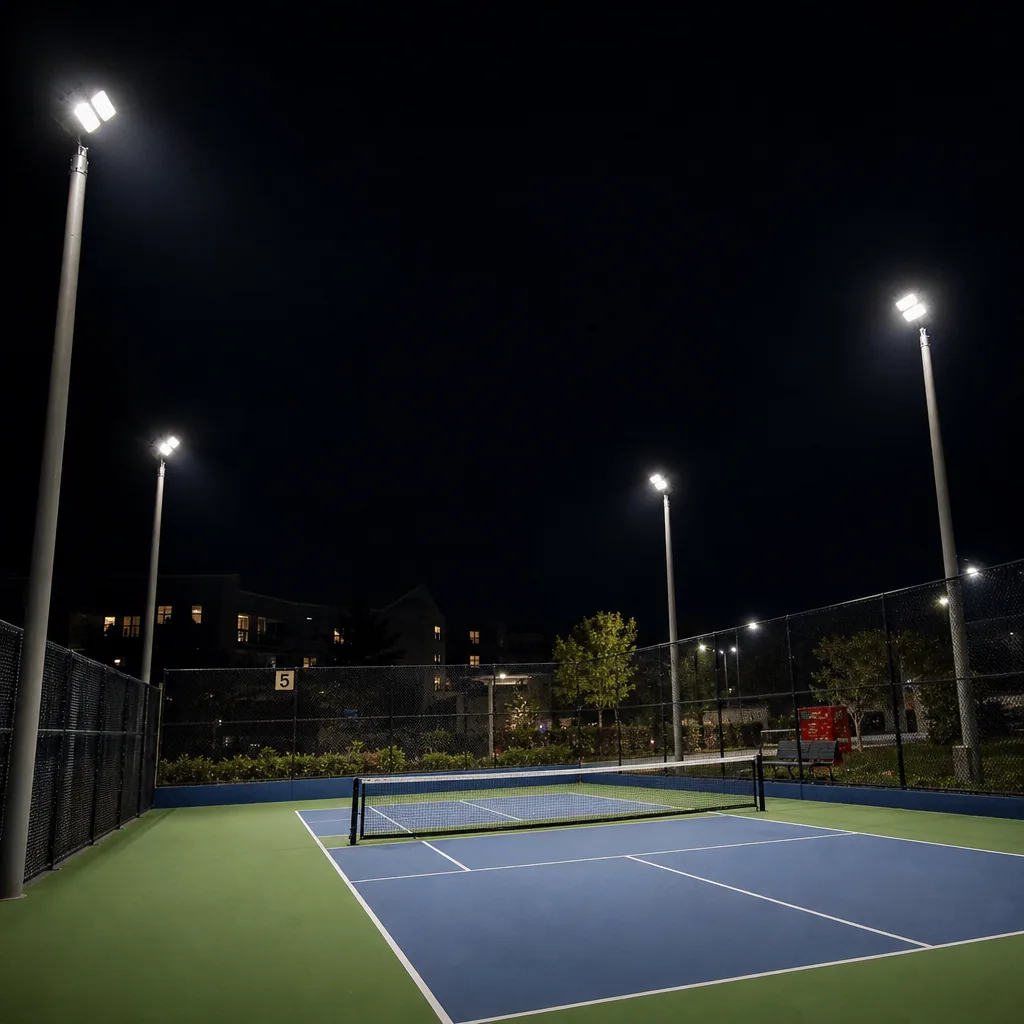
The headline conclusion is simple: luminaires on a pickleball court should sit lower than on a tennis court.
A tennis court is typically lit from around 9 m. Reusing that mounting height on a pickleball court to save effort is the single most common mistake, and the result is immediate glare once play starts.
Why copying tennis height causes glare
The smaller the court, the closer players stand to the luminaires, and the steeper the angle at which they look up into them. A pickleball court is only 13.4 m by 6.1 m, less than a quarter of a tennis court.
Mount a luminaire at 9 m over a court this small and the head sits almost directly above the players. Every upward glance meets the LED array. That is glare in its most literal form.
Step one: set the mounting height at 6 to 8 m
Tools: tape measure, pole or wall-mounted bracket.
For a single court, aim for a mounting height of 6 to 8 m, lower than the tennis reference.
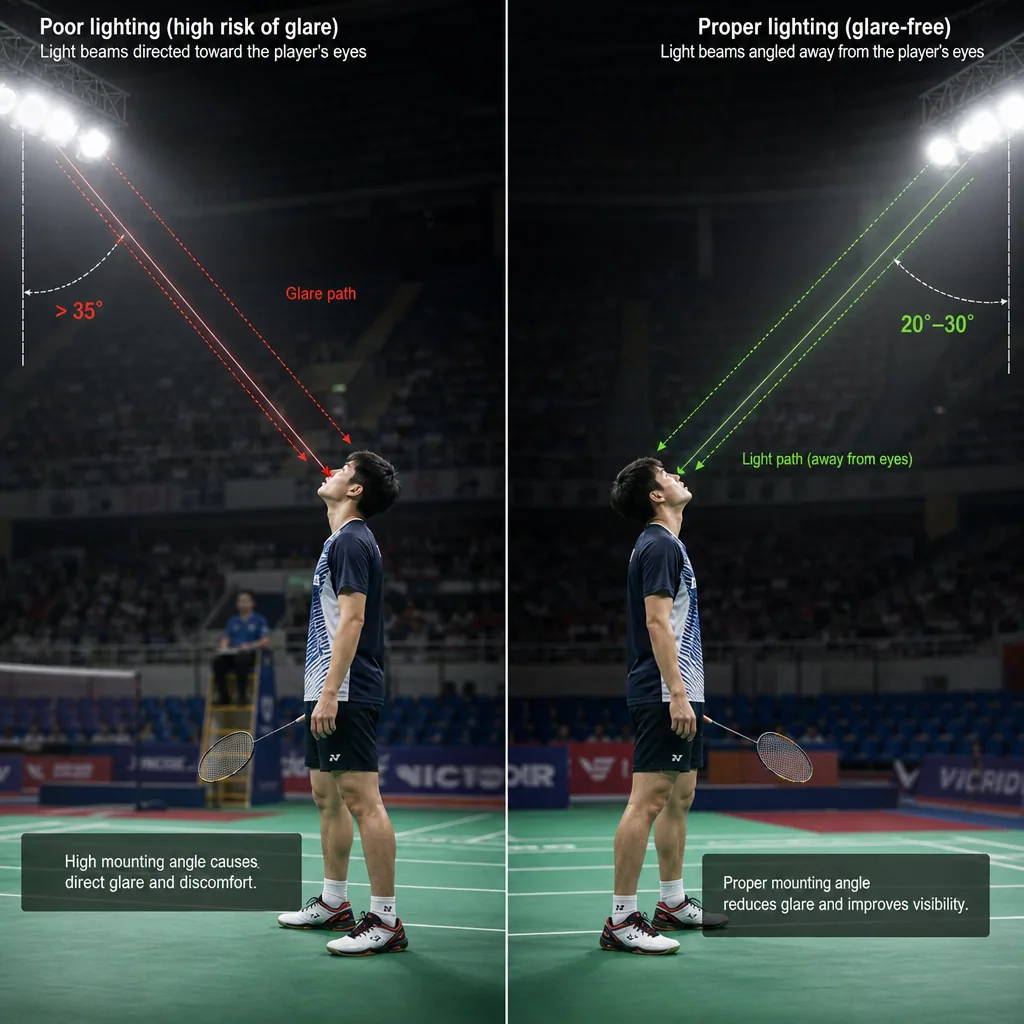
Lowering the height reduces glare rather than increasing it. With the luminaire set lower and the head angled slightly toward the court, the player's line of sight falls to the side and behind the fixture instead of straight below it. The vertical angle at which the eye meets the source shrinks, and the sensation of glare drops noticeably.
Check: have a player stand at the receiving position and look up. If the LED array points straight at the eyes, the fixture is too high or wrongly aimed. Rework it.
Step two: lay out 4 to 8 luminaires symmetrically
Tools: court drawing, symmetry centreline.
For a standard 13.4 m by 6.1 m court, two layouts work well:
- One luminaire at each corner, four total, sufficient for recreational play.
- Two to four luminaires per side, four to eight total, more stable for competition.
Symmetry matters because a single-sided layout leaves the far ground darker, and players lose track of where the ball lands. Balanced placement keeps brightness even across the court with no obvious dark corner.
Check: the number, wattage and mounting height of luminaires must match on both sides. Even one fixture out of balance skews the illumination to one side.
Step three: keep inward tilt at 25 degrees or less
Tools: angle gauge or phone level.
Tilt the head inward toward the court, but not beyond 25 degrees.
Inward tilt carries light to the centre of the court. Push the tilt too far and the array sweeps directly across the eyes of the player on the opposite side, which reintroduces the glare problem. Around 25 degrees is the balance point between reaching the centre and not scanning across players' faces.
One principle governs the aim: the receiving position is where players look up most often, so the main beam direction should avoid that line of sight. A player should not stare into a luminaire the moment they receive serve.
Check: crouch at the receiving position and look along the player's line of sight. The fixture should not sit directly ahead.
Step four: verify illuminance and uniformity with nine points
Tools: one illuminance meter.
Illuminance is how bright the playing surface is, measured in lux. The higher the number, the brighter the surface.
- Recreational: 300 lx at the surface, adequate for casual play.
- Competition: 500 lx, for formal matches and clearer tracking of where the ball lands.
Brightness alone is not enough; the light must be even. The metric is overall uniformity U0, which should be 0.5 or higher. U0 is the darkest reading divided by the average. A value of 0.5 means even the darkest spot carries half the average level, so there are no bright patches next to black ones.
This leads to the second common mistake: measuring only the centre and missing the corners.
The centre is usually the brightest point. Measure it alone and the result passes, and the sign-off feels easy. But the ball often lands near the baselines and corners, which are the darkest areas. Measuring only the centre skips exactly the zone that most needs checking.
The correct method is nine-point measurement. Overlay a grid of nine points across the court: the centre, the midpoint of each side, and the four corners. Read every point with the meter, then compute uniformity.
Check: the lowest of the nine readings divided by the average of the nine must be 0.5 or higher. If any corner reads too dark, the whole court fails.
The principle of measuring the full field rather than the centre alone is familiar from broadcast-driven retrofits. Where older acceptance practice tracked only centre illuminance, modern broadcast standards require uniformity across the whole field. Many older venues were caught out by dark zones at the corners and baselines and had to add fixtures. A pickleball court is small, but the logic is identical: if the edges fail, a bright centre is wasted.
One-page self-check list
- Mounting height 6 to 8 m, lower than tennis at 9 m?
- Four to eight luminaires, symmetric and matched side to side?
- Inward tilt 25 degrees or less, clear of the receiving line of sight?
- 300 lx recreational or 500 lx competition, achieved?
- All nine points measured, U0 at least 0.5, corners not skipped?
Sign off only when all five are ticked.
Photometric distribution and glare control differ between manufacturers, so for a specific court it is worth asking an experienced sports lighting supplier such as LightPreformance to run a photometric simulation before installation and to share comparable references.