Six Golf Course Lighting Faults That Drive Players Away at Night
Six recurring lighting failures on golf courses — from illuminance uniformity to flicker and glare — that affect player experience and how to identify them.
Why "Bright Enough" Is the Wrong Question
Course owners specifying night lighting tend to focus on wattage and installed cost. Players who actually use the course after dark complain about something else entirely. The two conversations rarely overlap, and the gap between them shows up in avoidable performance failures.
The six problems below come from repeated site surveys and player interviews on illuminated golf courses. Each one is measurable, each one has an established reference parameter, and none of them requires a full redesign to catch early — provided you know what to look for.
1. Illuminance Uniformity: Bright Patches and Dead Zones
Uniformity ratio — the minimum-to-maximum illuminance ratio across the playing surface — is a foundational metric for any sports lighting scheme. Accepted practice for golf requires a uniformity ratio of at least 0.5, meaning the dimmest point on the course should hold at least half the illuminance of the brightest.
Many installed courses fall short. The area immediately beneath a luminaire column reads like noon; the landing zone 40 metres away reads like dusk. The practical consequence is not just discomfort. When a ball lands near a sharp light-to-dark boundary, the player's eye needs 3–5 seconds to adapt — and the next shot decision is already forming. Distance and lie judgement suffer in that window.
2. Vertical Illuminance: The Ball in Flight Disappears
Standard site assessments measure horizontal illuminance — light falling on the ground plane. Golf adds a demand most other sports do not: the ball spends a significant portion of play airborne, and players must track it against a dark sky.
That requires adequate vertical illuminance, measured on a plane perpendicular to the ground. As a design target, vertical illuminance should reach roughly 60% of the horizontal value at key tracking heights. Many installations meet horizontal targets while delivering vertical illuminance of only 30–40% of horizontal, because luminaires are aimed primarily downward and the optical distribution is never evaluated on the vertical plane.
The result is a ball that leaves the tee cleanly visible, then effectively vanishes in the mid-flight phase against the night sky.
3. Flicker: Invisible to the Eye, Not to the Visual System
Flicker above roughly 100 Hz is below the threshold of conscious perception. That does not mean it is harmless over a 3–4 hour round.
LED luminaires driven by poor-quality control gear produce light output that oscillates with the AC supply frequency — tens to hundreds of cycles per second. The eye does not register the flicker as such, but the visual cortex continues processing the changing signal. The subjective effect, sustained over several hours, is cumulative eye fatigue and, in some cases, headache after play.
Flicker index (also referred to as percent flicker) is the measurement. Well-engineered LED drivers can hold this below 1%; products at the lower end of the market commonly test above 20–30%. The difference is measurable with standard photometric instrumentation. A site where players consistently report headaches after night rounds is worth testing with a flickermeter before any other investigation.
4. Glare: The Follow-Through Look Directly Into the Fitting
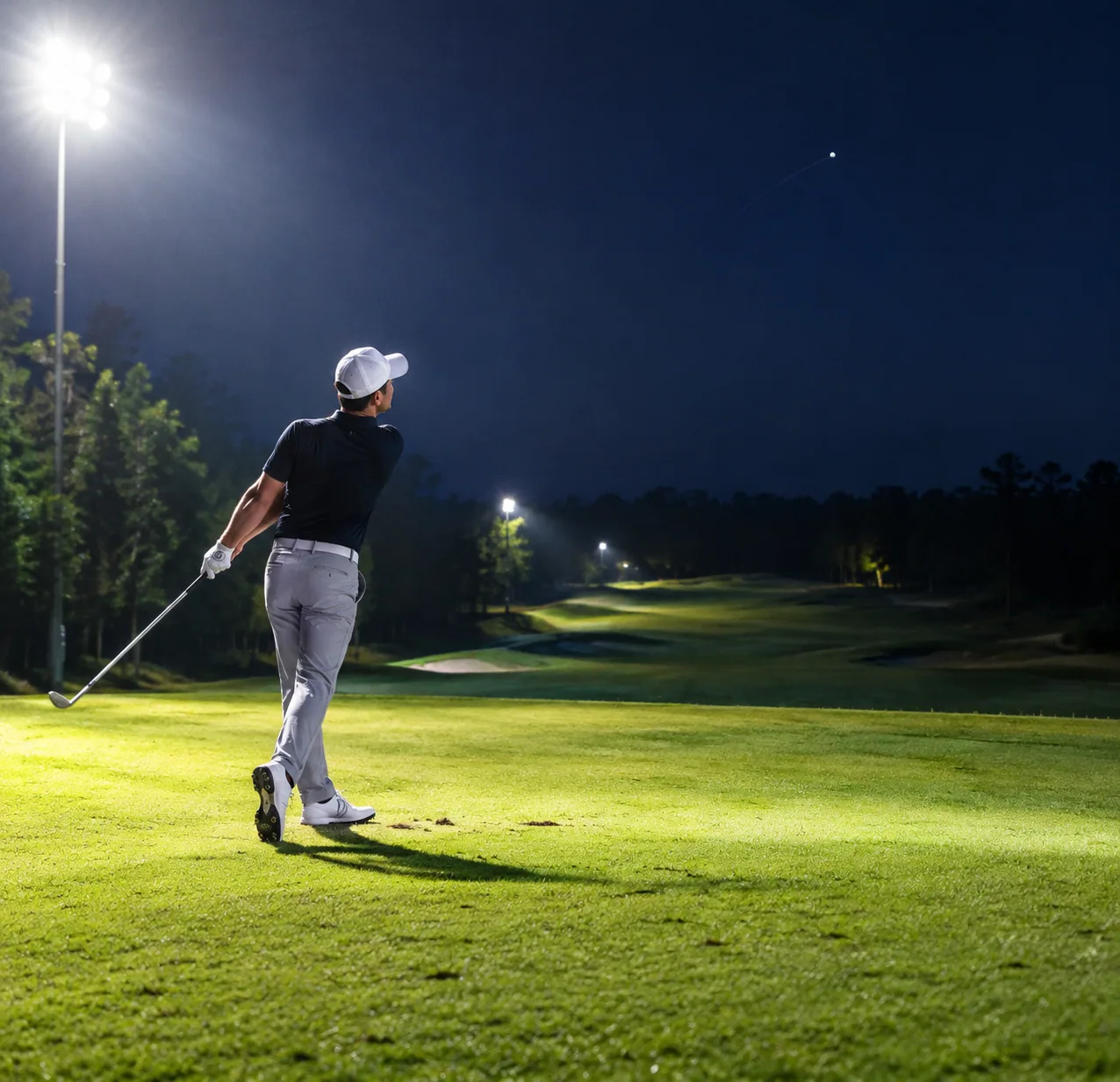
Golf requires players to track the ball after impact by tilting the head upward and back — a posture that points the eyes toward the luminaire plane. On a course with poorly controlled optics or badly placed columns, that motion puts a high-luminance source directly in the player's field of view at the worst possible moment.
Glare rating for outdoor sports is expressed as GR (Glare Rating), where lower values indicate less glare. Outdoor sports installations generally target GR ≤ 50. When mounting geometry and beam distribution are not specifically designed around the follow-through sightline of a golfer, measured GR values of 55–60 or above are common.
LED sources exacerbate this relative to older lamp technologies. Higher correlated colour temperatures produce spectrally harder light, and a small, bright LED chip concentrates luminance in a way that a diffuse discharge lamp does not. Optical control — secondary lenses, baffles, or tight cutoff distributions — is not optional on a golf installation; it is load-bearing.
5. Colour Temperature and Colour Rendering: The Course Looks Wrong
Colour temperature shapes how the playing surface reads. At 6500 K, turf shifts toward blue-green under the camera and under the eye; the white ball loses contrast against pale backgrounds; and the overall atmosphere is clinical rather than neutral. Players sometimes describe it as playing under hospital corridor lighting — an impression that affects perceived comfort even when measured illuminance is adequate.
The appropriate CCT range for golf night play is 4000–5000 K. This keeps turf rendering natural, preserves the white-ball contrast players rely on for trajectory reading, and produces a playing environment that feels coherent rather than harsh.
Colour rendering index (CRI / Ra) is the parallel concern. A minimum Ra of 80 is required to distinguish the true colour and lie of turf, rough, sand, and shadow. Below 80, the eye receives a plausible but inaccurate colour signal — enough to navigate, not enough to make precise lie judgements.
| Parameter | Recommended value | Common underperforming range |
|---|---|---|
| CCT | 4000–5000 K | 6000–6500 K |
| CRI (Ra) | ≥ 80 | 65–75 |
| Uniformity ratio | ≥ 0.5 | 0.3–0.4 |
| Vertical / horizontal illuminance | ≥ 60 % | 30–40 % |
| GR | ≤ 50 | 55–65 |
| Flicker index | < 1 % | 20–30 % |
6. Layout Ignoring Terrain and Vegetation
Photometric simulation is an essential design tool, but it models a simplified geometry. A golf course is not simplified: mature trees, elevation changes, and water hazards create shadow patterns and wind-induced movement that no CAD file captures unless someone has walked the site.
Two failure modes appear repeatedly. First, in wind, columns experience minor oscillation that produces a visible sweep of light across the fairway — not dramatic, but perceptible and distracting in low-wind conditions when players are expecting a stable visual field. Second, tall trees positioned between a luminaire and the playing surface cast hard shadows that bisect fairways into alternating bright and dark bands. Players in the shadow zone lose the surface texture information that informs lie and distance judgement.
Both are preventable with a pre-design site walk to record dominant wind direction, principal tree canopy edges, and elevation transitions — information that feeds directly into column placement decisions. Retrofitting a supplementary column to correct a tree-shadow problem is straightforward; finding it after installation is an unnecessary cost.
A Simple Field Check for Course Managers
Before commissioning a photometric survey, a structured conversation with regular night players yields a fast initial screen. Three questions cover the most common failure modes:
- Do you ever lose sight of the ball in flight before it lands?
- Do you feel eye fatigue or a headache after a night round?
- Is there any hole where looking up to track the ball causes a blinding flash?
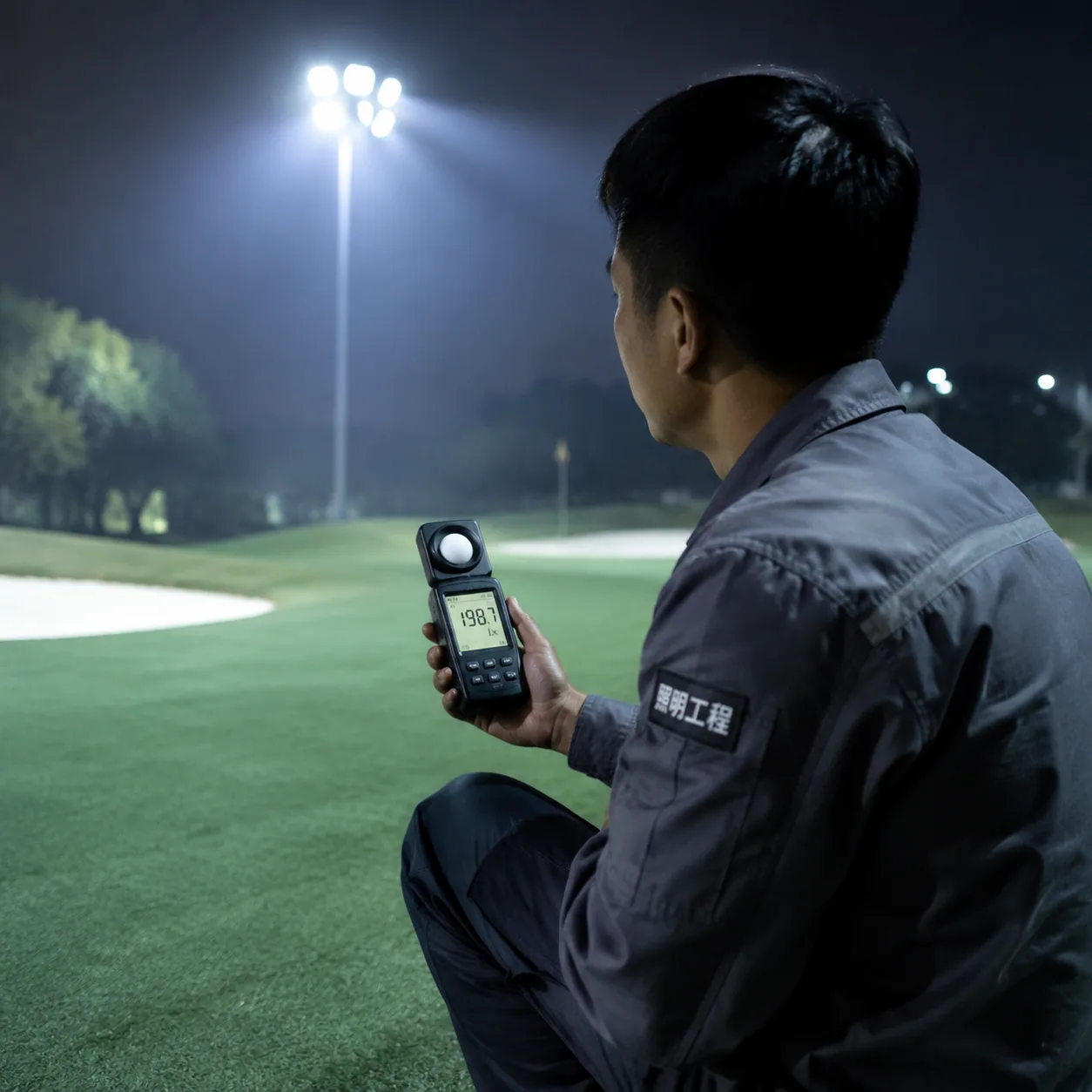
Two or more affirmative answers from multiple players indicates a systemic issue worth quantifying. Determining which parameter is out of tolerance requires on-site measurement — illuminance meter, luminance meter, and flickermeter — referenced against the design specification.
LightPreformance's site assessment teams carry this instrumentation and can provide a measured baseline against internationally recognised sports lighting criteria. If the numbers are there, the fix is usually targeted; the expensive outcome is finding out years later through declining night-play revenue.