Flicker Percent and SVM: The Broadcast Threshold Your Eyes Will Miss
Why Flicker Percent below 1% and SVM at or below 1 are the non-negotiable thresholds for broadcast-grade arena and stadium lighting.
What Flicker Percent Actually Measures
LED luminaires do not emit a perfectly constant output. The driver converting mains AC to DC current for the LED array can introduce periodic ripple in that current — a cycle of slightly higher and slightly lower output repeating many times per second. Flicker Percent quantifies the depth of that ripple.
The formula is straightforward: subtract the minimum luminous intensity from the maximum, divide by their sum, and multiply by 100. A result of 0% means no variation at all. A result of 100% means the luminaire is cycling between full output and complete extinction.
Human vision detects flicker reliably below roughly 80–100 Hz. Above that threshold, the visual system integrates the fluctuations and perceives a steady source — which is why a luminaire with significant high-frequency ripple can pass a visual inspection entirely. The camera does not share that limitation.
Rolling Shutter and Why Cameras Are the Honest Judge
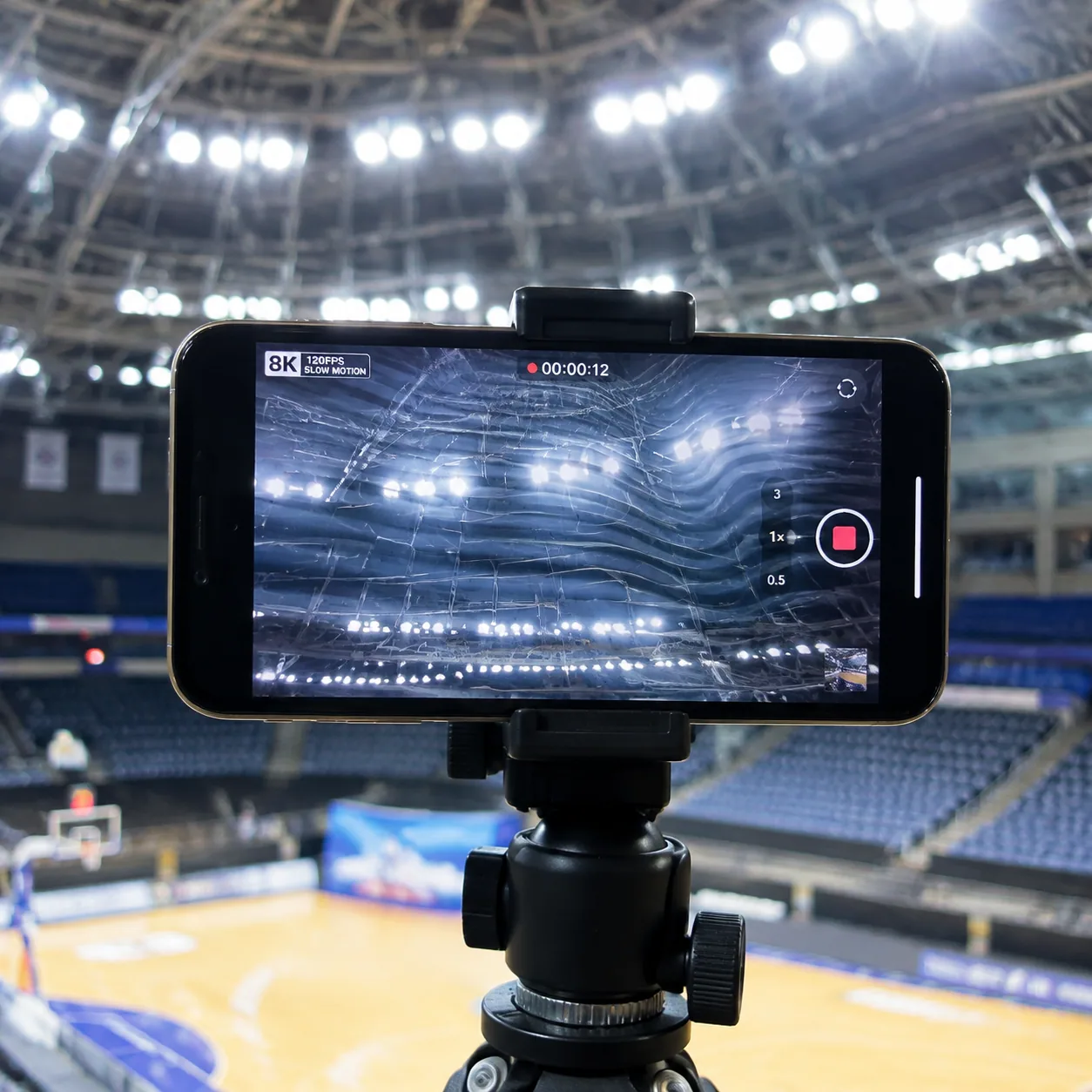
Modern broadcast and high-frame-rate cameras use rolling shutter sensors, which scan the image plane row by row from top to bottom rather than exposing the entire frame simultaneously. If luminous output is oscillating during that scan, successive rows capture different intensity levels. The result on playback is a pattern of horizontal bands that scroll slowly through the frame — sometimes described as "banding" or "scan lines."
Slow-motion replay makes the problem worse, not better. High-frame-rate capture increases the scan frequency of the sensor, raising the probability that the sensor's own timing will beat against the light's oscillation frequency. The interaction of the two frequencies produces a beat pattern that becomes clearly visible at slow-motion playback speeds — speeds now routine in broadcast coverage of any major sporting event.
A luminaire that looks perfectly acceptable to every person in the venue can produce visible banding the moment a broadcast director cuts to a slow-motion replay. That failure reaches every screen carrying the feed.
SVM: From Raw Ripple to Perceived Effect
Stroboscopic Visibility Measure (SVM) is a separate but complementary metric. Where Flicker Percent describes the amplitude of the ripple, SVM weights that ripple against the human visual system's sensitivity at each frequency — because the eye is not equally sensitive across the flicker spectrum. Low-frequency oscillations produce a stronger perceptual response than high-frequency ones of the same amplitude, and SVM encodes that relationship.
A useful analogy: Flicker Percent tells you the height of waves on the water. SVM tells you whether those waves are likely to cause motion sickness. Both measurements matter, and neither replaces the other.
| Metric | What it measures | Broadcast-grade threshold |
|---|---|---|
| Flicker Percent | Depth of luminous ripple (amplitude) | < 1% |
| SVM | Human-perceptible stroboscopic effect | ≤ 1 |
For ordinary commercial or recreational lighting, tolerances are substantially wider — Flicker Percent below 5% is adequate for most indoor fitness or retail environments. Broadcast-grade venues operate in a different category entirely, because the camera is the audience.
Driver Architecture and Where Flicker Originates
Flicker is primarily a driver problem, not a chip problem. Two dimming architectures dominate the market:
PWM (Pulse Width Modulation) dimming controls output intensity by switching the current on and off at high frequency, modulating the proportion of on-time to off-time. At the switching frequency itself, the luminaire is technically cycling between full output and zero — though at frequencies above roughly 1,000 Hz the perceptual effect diminishes significantly. At lower PWM frequencies, or when the switching interacts unfavourably with camera frame rates, banding becomes a real risk.
Analogue (constant-current) dimming reduces intensity by lowering the DC current level. The luminaire remains continuously energised; only the magnitude of the current changes. This architecture inherently produces lower Flicker Percent because there is no switching event to create a periodic on/off cycle.
High-performance stadium and arena drivers typically combine high-frequency PWM (operating above 10 kHz, well beyond camera sensitivity thresholds) with analogue dimming, or use pure constant-current regulation across the dimming range. The critical question is not which architecture is claimed, but what the measured waveform shows at each operating point.

Reading a Compliant Test Report
A specification sheet listing Flicker Percent at 100% output is necessary but not sufficient. Dimming is standard practice in modern venue operation — for energy management, for scene-setting during events, and for TV-optimised lighting levels that differ from public-entry levels. A luminaire that meets the broadcast threshold at full power but drifts significantly at 75%, 50%, or 25% output is not a broadcast-grade product.
A credible third-party test report for broadcast applications should include:
- Flicker Percent and SVM measured at a minimum of four dimming levels: 100%, 75%, 50%, and 25%
- Waveform plots at each level (the oscilloscope trace of luminous output over time)
- Laboratory identification, test date, and the measurement standard applied
The waveform plot is the most direct check. A true constant-current driver produces a nearly horizontal line. A driver with significant ripple shows clear peaks and troughs. The shape is visible at a glance and cannot be misrepresented by selective reporting of summary figures.
LightPreformance's specification process requires third-party photometric and flicker testing before any luminaire is approved for broadcast-venue projects, with waveform documentation mandatory at all four dimming points.
The Gap Between What Eyes Report and What Cameras Record
The most common misconception in venue lighting specification is equating visual comfort with broadcast compliance. They are related but separate standards.
A luminaire with Flicker Percent at 20% and SVM above 3 will be described by most people in normal observation conditions as "steady" — the visual system smooths out the variation. Under slow-motion broadcast conditions, that same luminaire will produce prominent banding. The gap between what human observers report during a site visit and what a broadcast camera records is wide enough to invalidate a complete lighting scheme after installation.
Long-duration exposure to high-frequency flicker below conscious perception has also been associated with visual fatigue and reduced concentration in some research contexts, even when occupants report no subjective awareness of flicker. This is relevant for athletes in training environments, not only for broadcast performance.
Visual testing during commissioning has a role, but it cannot replace measured data. A slow-motion video check using a current smartphone at 240 fps or higher is a useful first filter on site — visible banding at that frame rate indicates a serious problem. Absence of visible banding at consumer frame rates does not confirm compliance; it only rules out the most severe failures.
Specification Checklist for Broadcast-Grade Flicker Performance
Before accepting a luminaire for any venue with broadcast or high-frame-rate recording requirements:
- Request a third-party laboratory test report, not a manufacturer self-declaration, covering Flicker Percent and SVM at 100%, 75%, 50%, and 25% dimming
- Confirm Flicker Percent is below 1% and SVM is at or below 1 at every tested dimming level, not only at full output
- Verify the report includes waveform plots and check that the waveforms are consistent with the claimed constant-current or high-frequency PWM architecture
- Conduct a slow-motion camera test on the installed system before final acceptance, at the dimming levels that will be used during broadcast operation
LightPreformance's engineering team can review test documentation and advise on driver architecture for specific broadcast requirements.